Captions are important to make sure everyone—including deaf, hard-of-hearing, and viewers who speak other languages—can enjoy videos on YouTube.
In 2009, you first saw a feature that automatically creates captions on YouTube videos in English, and since then we’ve added Japanese, Korean, and Spanish. Today, hundreds of millions of people speaking six more languages—German, Italian, French, Portuguese, Russian, and Dutch—will have automatic caption support for YouTube videos in those languages. Just click the closed caption button on any of these videos to see how it works:
Now in 10 languages, automatic captions are an important first step in the path toward high-quality captions for the 72 hours of video people upload per minute. As automatic captions will have some errors, creators also have several tools to improve the quality of their captions. Automatic captions can be a starting point, where creators can then download them for editing, or edit them in-line on YouTube. Creators can also upload plain-text transcripts in these languages, and the same technology will generate automatically-synchronized captions.
You now have around 200 million videos with automatic and human-created captions on YouTube, and we continue to add more each day to make YouTube accessible for all.
Hoang Nguyen, software engineer, recently watched “Completo, ilha das flores.”
Showing posts with label accessibility. Show all posts
Showing posts with label accessibility. Show all posts
Wednesday, 28 November 2012

Friday, 15 June 2012
YouTube automatic captions now available in Spanish
Cross posted from the Blog de YouTube en Español
Last year, YouTube had more than 1 trillion views, or about 140 views for every person on earth. As the world tunes in to YouTube, we want everyone, in every language, to have the same opportunity to enjoy YouTube. So today, we’re expanding our language accessibility to add automatic captions in Spanish.
When a video has recognizable speech, you’ll see a “CC” button appear in the bottom of the player, which will instantly add captions of the video in Spanish. Just look for this icon and click “Transcribe Audio.”


The hundreds of millions of Spanish speakers in the world are the latest to see the auto-caption feature, adding to other available languages of English, Japanese and Korean. You’ll find auto-captions available on more than 157 million videos, with videos being added every day. We’ll continue to refine our speech recognition technology, and you can learn more about how it works here. See it in action on this video, by clicking the CC:
If you want to see YouTube videos in even more languages, you can combine auto-captions with our auto-translate feature to generate subtitles in more than 50 languages. For creators, upload a Spanish transcript with your video and we’ll automatically create timecoded captions. You can even download the automatic captions, all from your Video Manager.
We’re launching new countries and languages all the time, as we work to make YouTube accessible and enjoyable to all.
¡Nos vemos en YouTube!
Hoang Nguyen, software engineer, recently watched "Casillas: 'Si la Eurocopa hubiese sido en 2011, habría habido más problemas.'"
Last year, YouTube had more than 1 trillion views, or about 140 views for every person on earth. As the world tunes in to YouTube, we want everyone, in every language, to have the same opportunity to enjoy YouTube. So today, we’re expanding our language accessibility to add automatic captions in Spanish.
When a video has recognizable speech, you’ll see a “CC” button appear in the bottom of the player, which will instantly add captions of the video in Spanish. Just look for this icon and click “Transcribe Audio.”
The hundreds of millions of Spanish speakers in the world are the latest to see the auto-caption feature, adding to other available languages of English, Japanese and Korean. You’ll find auto-captions available on more than 157 million videos, with videos being added every day. We’ll continue to refine our speech recognition technology, and you can learn more about how it works here. See it in action on this video, by clicking the CC:
If you want to see YouTube videos in even more languages, you can combine auto-captions with our auto-translate feature to generate subtitles in more than 50 languages. For creators, upload a Spanish transcript with your video and we’ll automatically create timecoded captions. You can even download the automatic captions, all from your Video Manager.
We’re launching new countries and languages all the time, as we work to make YouTube accessible and enjoyable to all.
¡Nos vemos en YouTube!
Hoang Nguyen, software engineer, recently watched "Casillas: 'Si la Eurocopa hubiese sido en 2011, habría habido más problemas.'"
Tuesday, 28 February 2012
Captions for all: more options for your viewing and reading pleasure
Since we first announced caption support in 2006, YouTube creators have uploaded more than 1.6 million videos with captions, growing steadily each year. We’ve also enabled automatic captions for 135 million videos, more than tripling the number of captioned videos available since July 2011. YouTube and Google’s video accessibility team have been hard at work, and we wanted to let you know about some of our progress over the past few months:
For YouTube viewers
More languages: We now support automatic captions and transcript synchronization in Japanese, Korean, and English. Speech recognition for those languages makes it easier for video owners to create captions from a plain transcript. Video owners can also add captions and subtitles in 155 supported languages and dialects, from Afar to Zulu. In Movies and Shows, you can even find out which subtitle languages are available before deciding to rent.

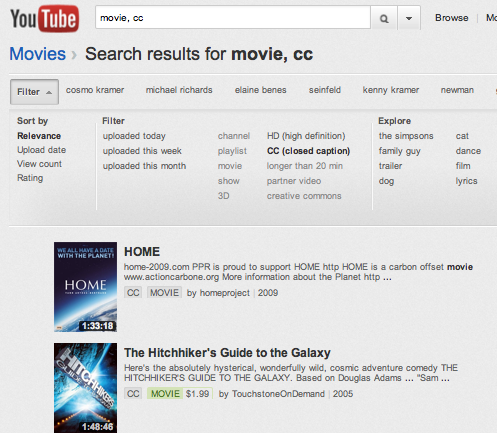
Search for videos with captions: Looking for that great quote from a video on YouTube? Add ", cc" to any search, or after searching, click Filter > CC to only see results with closed captions.
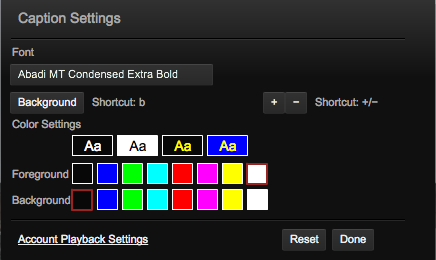
Caption settings: While watching a video, you can change the way the captions look by clicking on the “CC” icon and then the “Settings...” menu item. This includes changing the font size or colors used, and we’re planning to make this available on other platforms and add more options soon.
Broadcast caption support: If the channel owner provides a video caption file in a broadcast format, we now support its position and style information, just like you’d see on TV. This means the text can appear near the character who is speaking, italicized to indicate an off-camera narrator, or even scrolling if the original captions were generated in a real-time mode. Check out this little demo from CPC to see how it looks, or even watch a rental movie with captions like those available from The Walt Disney Studios.
For YouTube creators
More supported formats: YouTube now supports many of the common caption formats used by broadcasters, such as .SCC, .CAP, EBU-STL, and others. If you have closed captions that you created for TV or DVDs, we'll handle the conversion for you.
MPEG-2 caption import: If you upload an MPEG-2 video file that contains closed captions with CEA-608 encoding, we'll import the captions along with the video and create YouTube captions. For example, the nonprofit organization Public.Resource.Org recently added thousands of public domain videos with closed captions to YouTube, coming from government agencies like the National Archives. Here’s some insight from Carl Malamud, President, Public.Resource.Org:
Along with the millions of people like myself who rely on captions and subtitles, we were very encouraged when the Federal Communications Commission published rules governing closed captioning requirements for video on the web, whether that’s to your computer, tablet, phone or other device. We hope these new regulations will drive captions closer to becoming ubiquitous for video everywhere, and in the meantime we’ll keep developing more ways for you to enjoy all the great channels on YouTube.
Ken Harrenstien, software engineer, recently rented “Cars 2” and was ecstatic to see its awesome captions.
For YouTube viewers
More languages: We now support automatic captions and transcript synchronization in Japanese, Korean, and English. Speech recognition for those languages makes it easier for video owners to create captions from a plain transcript. Video owners can also add captions and subtitles in 155 supported languages and dialects, from Afar to Zulu. In Movies and Shows, you can even find out which subtitle languages are available before deciding to rent.
Search for videos with captions: Looking for that great quote from a video on YouTube? Add ", cc" to any search, or after searching, click Filter > CC to only see results with closed captions.
Caption settings: While watching a video, you can change the way the captions look by clicking on the “CC” icon and then the “Settings...” menu item. This includes changing the font size or colors used, and we’re planning to make this available on other platforms and add more options soon.
Broadcast caption support: If the channel owner provides a video caption file in a broadcast format, we now support its position and style information, just like you’d see on TV. This means the text can appear near the character who is speaking, italicized to indicate an off-camera narrator, or even scrolling if the original captions were generated in a real-time mode. Check out this little demo from CPC to see how it looks, or even watch a rental movie with captions like those available from The Walt Disney Studios.
For YouTube creators
More supported formats: YouTube now supports many of the common caption formats used by broadcasters, such as .SCC, .CAP, EBU-STL, and others. If you have closed captions that you created for TV or DVDs, we'll handle the conversion for you.
MPEG-2 caption import: If you upload an MPEG-2 video file that contains closed captions with CEA-608 encoding, we'll import the captions along with the video and create YouTube captions. For example, the nonprofit organization Public.Resource.Org recently added thousands of public domain videos with closed captions to YouTube, coming from government agencies like the National Archives. Here’s some insight from Carl Malamud, President, Public.Resource.Org:
Many of the DVDs and VHS tapes lying around in our vaults and attics--particularly those that were produced by governments and others that care about accessibility of their videos--already have Closed Captions embedded in them. Pulling that information out automatically and making it visible on YouTube means that these videos will continue to be accessible to new generations of viewers.
Along with the millions of people like myself who rely on captions and subtitles, we were very encouraged when the Federal Communications Commission published rules governing closed captioning requirements for video on the web, whether that’s to your computer, tablet, phone or other device. We hope these new regulations will drive captions closer to becoming ubiquitous for video everywhere, and in the meantime we’ll keep developing more ways for you to enjoy all the great channels on YouTube.
Ken Harrenstien, software engineer, recently rented “Cars 2” and was ecstatic to see its awesome captions.
Subscribe to:
Posts (Atom)